

The Sacred Bottleneck: The Spiritual Meaning of Delays and Divine Timing
We treat every red light in our lives like a personal insult. Modern productivity culture has conditioned us to measure our worth by our velocity, whispering that if a door has not swung open by Tuesday afternoon, we either lack hustle or the universe has forgotten our address. Look at how we react when a flight cancels, a financing round stalls, or a long-awaited relationship hits an inexplicable wall. Our jaws clench. We refresh our inboxes forty times an hour, draft aggressive follow-up emails at midnight, and try to brute-force outcomes that clearly lack the structural readiness to stand. It is an exhausting way to inhabit a human body. In my research studying high-performing founders, athletes, and individuals navigating profound life transitions, I have watched people shatter their immune systems and wreck flourishing opportunities simply because they could not tolerate a six-week pause. We confuse motion with progress, convincing ourselves that speed equals alignment while ignoring the obvious truth that rushing a seed out of the soil kills the harvest before it ever breaks the surface.
What happens when we stop treating a delay as a denial and begin reading it as an intelligent calibration? Everything in our nervous system changes. Most people get this wrong because they view time strictly as a mechanical conveyor belt rather than an organic medium of ripening. Divine timing is not a whimsical fairy tale invented to console disappointed optimists; it is the intersection of internal readiness, environmental convergence, and the quiet mercy that keeps us from stepping onto stages we are not yet strong enough to hold.
Chronos Anxiety and the Neurobiology of Forced Friction
The ancient Greeks divided time into two distinct realms, and modern Western society has amputated one of them. We live almost entirely inside Chronos—quantitative, linear clock time measured in seconds, quarterly deadlines, and biological expiry dates. Chronos ticks relentlessly forward, breeding a low-grade existential panic that whispers we are falling behind an invisible schedule. When an external bottleneck disrupts our Chronos timeline, the brain does not register a neutral schedule adjustment; it registers a threat to status and survival.
Watch what unfolds inside your neurochemistry the moment an expected breakthrough stalls. The amygdala fires, triggering the hypothalamic-pituitary-adrenal axis to flood your bloodstream with cortisol and adrenaline. Your prefrontal cortex—the very region responsible for long-term strategic vision, nuance, and creative synthesis—narrows its aperture into tunnel vision. Behavioral scientists call this cognitive tunneling. Under the grip of Chronos anxiety, we lose our peripheral awareness. We miss obvious alternative pathways standing three feet to our left because we are too busy banging our fists against a locked oak door straight ahead.
I have tracked heart rate variability and sleep architecture in executives undergoing prolonged regulatory or legal delays, and the physiological toll mirrors acute physical trauma. By refusing to accept the reality of the pause, we keep our sympathetic nervous system pinned at redline for months on end. We burn through magnesium, spike systemic inflammation, and drain our dopamine reserves chasing micro-hits of false control. Fighting a delay does not speed up the clock. It merely ensures that when the gate finally opens, we stagger across the threshold too depleted to perform.
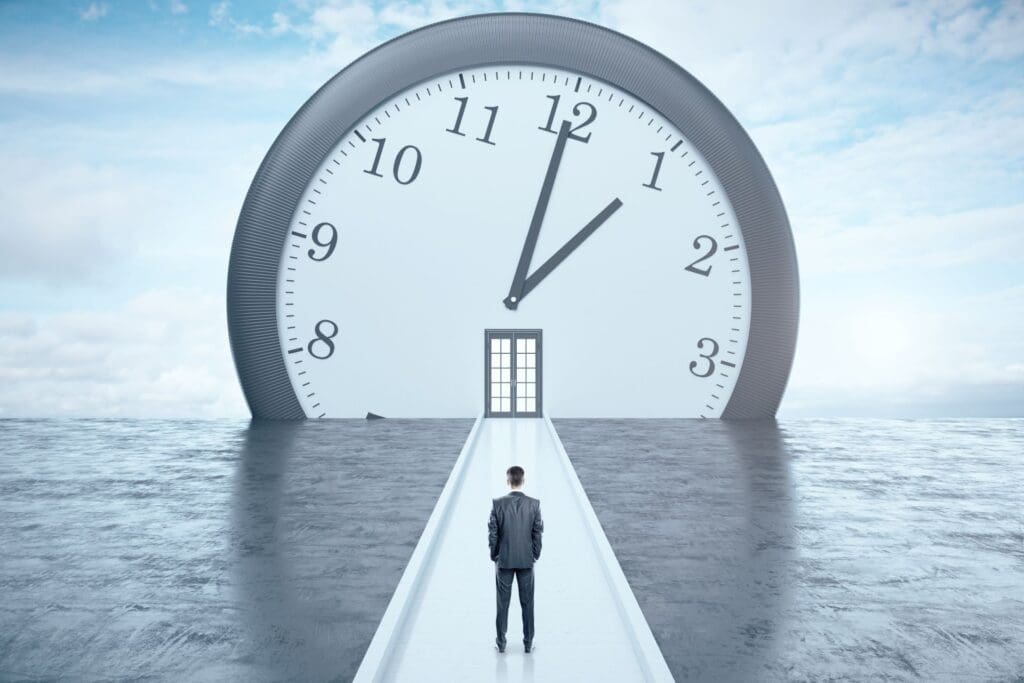
Incubation, Synaptic Pruning, and the Hidden Work of the Waiting Room
Nature never rushes, yet nothing gets left undone. Walk through an orchard in late February and the branches look dead, brittle, and utterly unproductive. Yet beneath the dark bark, complex hormonal shifts and carbohydrate conversions are unfolding at a cellular level so the blossoms can survive a late spring frost. Spiritual traditions across every continent honor this exact subterranean season, recognizing that divine timing protects us not only by preparing the blessing for us, but by preparing us for the blessing.
In cognitive psychology, researchers observe a remarkably similar phenomenon known as the incubation effect. When you wrestle furiously with a complex problem and hit an impasse, stepping away into apparent inactivity allows the brain’s unconscious associative networks to reorganize information behind the scenes. Weak, noisy neural connections undergo synaptic pruning while deeper, more resilient pathways consolidate.
Delays serve as spiritual and psychological incubation chambers. Think back to a major desire you chased five years ago—a job, a city, a partner—that slipped through your fingers or dragged out agonizingly past your deadline. Looking back with clear eyes, what would have happened if that door had opened on your original schedule? Chances are high that your emotional regulation, your boundaries, or your structural foundation would have buckled under the weight of what you thought you wanted.
In my clinical and advisory work, I have seen sudden, premature success destroy far more lives than prolonged delays ever have. When external expansion outpaces internal character formation, the resulting collapse is catastrophic. The waiting room is rarely empty. It is the exact workshop where impatience gets burned off, weak assumptions get exposed, and our nervous system expands its capacity to hold greater responsibility without fracturing.
Ego Deflation and the Autonomic Surrender to Kairos Time
If Chronos is the clock on the wall, Kairos is the second Greek concept of time—the appointed, qualitative moment when conditions ripen and action flows without friction. You cannot manufacture Kairos through sheer willpower, and that fact drives the human ego completely mad. Our ego craves authorship. It wants to write the script, cast the actors, set the premiere date, and take full credit when the curtain rises.
A prolonged delay acts like a precision scalpel aimed straight at the illusion of omnipotent control. At first, we bargain. We tweak our routines, read another strategy book, or try to negotiate with reality through frantic over-functioning. Eventually, when every lever fails to budge the timeline, we hit a wall of profound surrender. Spiritual mystics call this moment the death of self-will, yet in behavioral physiology, we can see it as an autonomic downshift from sympathetic hyper-arousal into grounded parasympathetic presence.
Notice what happens in your chest the exact instant you stop fighting a delay and say internally, “This is not moving right now, and I am going to stop bleeding energy trying to push a freight train uphill.” Your diaphragm drops two inches. The chronic tension between your shoulder blades melts. Your vagal tone rebounds, restoring blood flow to your gut and reopening the associative networks of your cortex.
When we step out of Chronos panic and enter Kairos receptivity, our perception sharpens dramatically. Instead of obsessing over why the train has not arrived, we suddenly notice the stranger sitting beside us on the bench, the book resting in our bag, or the quiet intuition nudging us to refine our craft while the station stays quiet. Surrender is not collapsing into defeat. Surrender is aligning your sails with the actual wind blowing across the water rather than exhausting yourself blowing into the canvas with your own lungs.
Discernment Over Passivity in the Face of Closed Doors
Let us bring a healthy dose of grounded skepticism into the room before anyone uses divine timing as a glossy excuse for procrastination. Spiritual concepts become dangerous the moment we turn them into sedatives that numb our adult agency. There is a massive difference between honoring sacred timing and hiding behind passivity because you are afraid of rejection, hard conversations, or visible failure.
How do we tell the difference between a legitimate spiritual delay and plain old avoidance? Look closely at the quality of your inner state and your daily discipline. Avoidance feels heavy, foggy, and numbing; it leaves your desk cluttered, your emails unanswered, and your skills gathering dust while you claim you are “waiting for a sign.” Authentic alignment with divine timing feels alert, clean, and fiercely prepared. You have done every single piece of work within your legitimate sphere of control. You trained the body, refined the proposal, had the honest conversation, and cleared the clutter—and now you rest with your boots laced up, ready to move the second the fog lifts.
Also, let us acknowledge a hard truth that pop-spirituality often glosses over: sometimes a delay does not lead to the outcome you originally prayed for at all. Sometimes the bottleneck is a permanent redirection, saving you from a path that looked glittering on the outside while harboring poison underneath. Trusting deeper timing requires holding our plans with open palms rather than a white-knuckled fist.
Look at the stalled chapter sitting in front of you today. Strip away the catastrophic stories your anxious mind has woven around the calendar. Ask yourself honestly whether there is one clean, courageous action left for you to take today, and if the answer is no, give yourself permission to put down the heavy stones you were never meant to carry. Breathe into the quiet space of the pause. Tend your garden, sharpen your instruments, steady your heart, and trust that nothing genuinely meant for your life can ever miss its appointed hour.
Thanks for stopping by!
We’d love to know what you think. Drop a comment below with your feedback or suggestions—we can’t wait to hear from you.
Wishing You The Best, Stable Grace Staff Writers & Editors