Animal Flow & Primal Movement: Why We Need to Move Like Beasts to Feel Like Humans
We build bodies that look like Greek statues and move like rusted forklifts. Step onto the rubber floor of any upscale health club and observe the strange choreography of modern human conditioning. Men and women sit strapped into padded vinyl seats, pushing steel levers forward and backward along fixed metal rods while staring at television screens mounted near the ceiling. Hips stay locked at ninety degrees. Spines rest passively against lumbar cushions. Ankles never roll, ribs never rotate, and palms never touch the earth. We call this functional fitness, yet the moment one of these sculpted athletes steps off a curb at an odd angle or reaches awkwardly into the backseat of a car, a lumbar disc herniates or a rotator cuff frays. It is a tragic biomechanical joke. In my research across sports medicine clinics and motor-control laboratories, I have watched marathoners and powerlifters with sub-ten-percent body fat fail basic developmental movement screens that a four-year-old child passes effortlessly. We have traded thirty-six degrees of joint freedom for the cosmetic illusion of strength, locking ourselves inside a linear cage of our own design.
Why do we feel so stiff, anxious, and disconnected inside bodies we spend hours training? Most people get this wrong because they treat the human organism like a collection of isolated meat parts rather than a unified, sensory-rich web of fascia and nerve fibers. When we restrict our physical vocabulary to squats, presses, and treadmill miles, we starve the brain of the complex three-dimensional telemetry it requires to feel safe in space. Returning to the floor—crawling, crouching, rolling, and transitioning through quadrupedal patterns like the beasts we evolved alongside—is not a circus trick for social media influencers. It is a neurobiological reclamation project.
The Sagittal Trap and the Sensory Amnesia of Modern Fitness
Human beings did not evolve on flat surfaces. For hundreds of thousands of years, our ancestors navigated uneven limestone, wet roots, tangled brush, and steep inclines that demanded constant, micro-second adjustments across every joint capsule from the big toe to the cervical spine. Today, we live in a sagittal-plane dictatorship. Look at your daily movement profile. You wake up, sit on the edge of the bed, sit at a breakfast table, sit in a commuter vehicle, sit at an ergonomic desk, and then walk into a gym where you perform lunges, bench presses, and stationary bike intervals. Every single one of those actions occurs in the forward-and-backward plane of motion.
Our rotational and lateral capabilities wither in the dark. In neurobiology, we follow a ruthless law: cortical real estate is competitive. Your primary somatosensory cortex holds an internal map of your physical body, often called the homunculus. When you stop moving your thoracic spine into lateral flexion, or when you go decades without bearing weight through an extended wrist and spread fingers, the brain literally blurs those regions on its internal map. This phenomenon is known as sensory-motor amnesia.
I have tested high-performing executives and recreational CrossFitters using two-point discrimination calipers along their mid-backs and hips. Many cannot tell whether I am touching their skin with one point or two unless the prongs are several inches apart. Because the brain cannot clearly perceive a joint whose full range of motion goes unused, it perceives that joint as unstable. And what does a protective central nervous system do when it senses instability? It pulls the emergency brake. It lays down low-grade muscular tension, restricts mobility, and sends chronic pain signals to keep you from venturing into unmapped physical territory. You do not have tight hamstrings because your muscles are physically short; you have tight hamstrings because your brain does not trust your pelvis to move outside a narrow, robotic groove.
Quadrupedal Neurogenesis and the Mechanics of Closed-Chain Groundwork
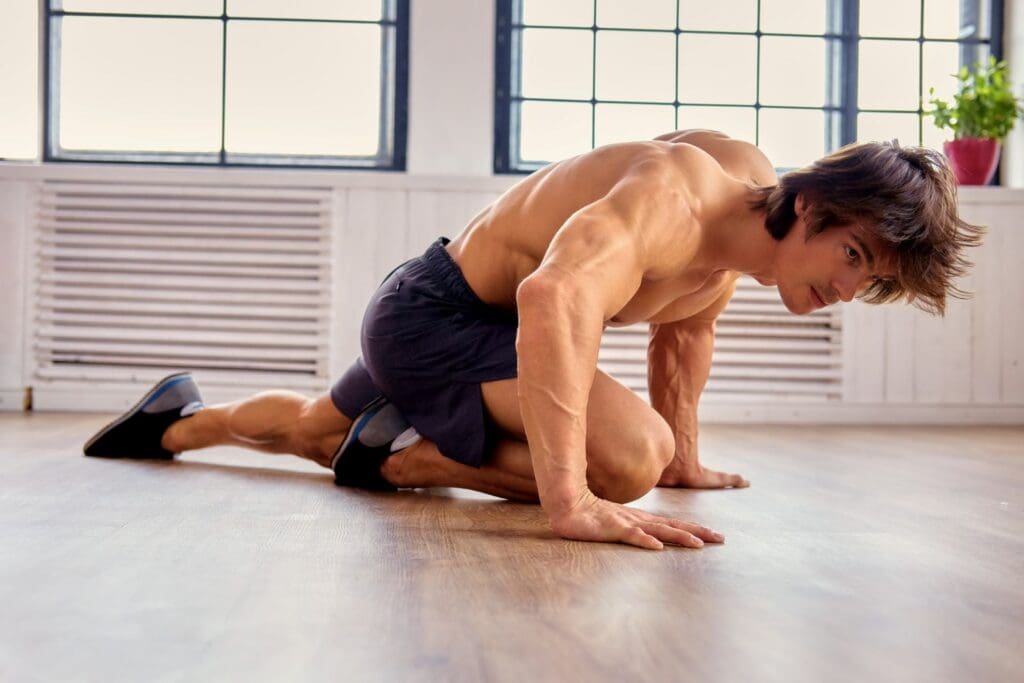
Drop to your hands and knees right now and lift your knees one inch off the floorboards. Everything changes in an instant. This foundational position—known in Animal Flow as the Beast activation—flips your biomechanical script from an open-chain upper body to a four-point closed kinetic chain. In a traditional gym exercise like a dumbbell shoulder press, your torso stays anchored while your hands move freely through space. When you place both hands and both feet onto the ground, your limbs become fixed pillars and your torso must navigate around them.
The neurological demand skyrockets. Your palmar surfaces pack thousands of Meissner’s corpuscles and Pacinian mechanoreceptors designed to read texture, pressure, and shear forces. Pressing your fingertips, knuckles, and heel of the hand actively into the floor sends a torrent of proprioceptive data straight up the brachial plexus into the cerebellum. Your rotator cuff no longer fires as a simple prime mover; it shifts into its true evolutionary role as a dynamic stabilizer, co-contracting in three dimensions to keep the humeral head centered inside the glenoid socket while your bodyweight shifts overhead.
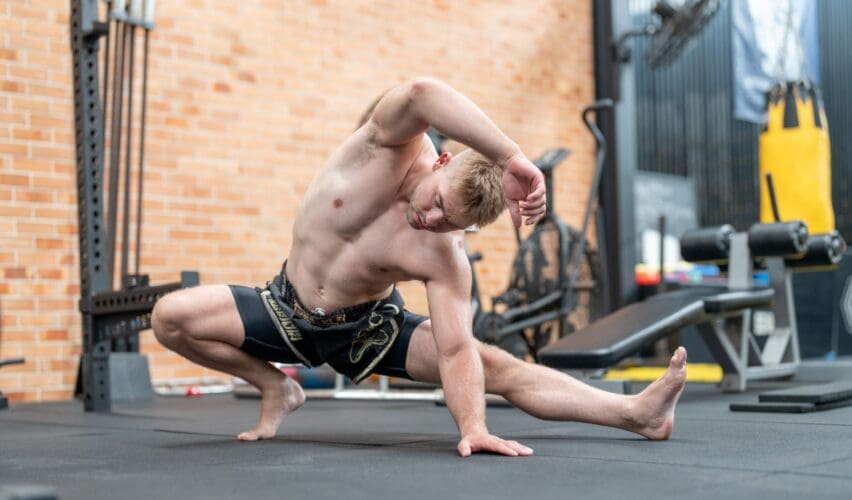
Watch what happens when an athlete transitions from a static quadrupedal hover into an Under-Switch or a Scorpion Reach. One foot peels off the floor, the pelvis rotates across the midline, the ribcage spirals in counter-rotation, and the supporting shoulder absorbs rotational torque while the opposite hip opens into full extension. This is cross-crawl patterning on steroids. Neurologists have long utilized cross-lateral crawling drills to rehabilitate stroke patients and children with developmental coordination disorders because contralateral limb movement forces the left and right cerebral hemispheres to communicate rapidly across the corpus callosum.
In my laboratory work analyzing electromyography readings during primal ground flows, a single fluid transition from a Beast hold into a Crab reach recruits more continuous deep-core musculature—specifically the transverse abdominis, internal obliques, and multifidus—than weighted barbell sit-ups or rigid front planks. Why? Because the spine must resist gravity while dynamically rotating and decelerating momentum. You cannot fake a quadrupedal transition with momentum the way you can heave a barbell off your chest. If your scapulae wing out or your core disengages for half a second during a Crab-to-Ape transition, you collapse onto the floor. The ground offers immediate, honest biofeedback that no cable machine can replicate.
Fascial Recoil, Vagal Tone, and the Somatic Release of Trapped Trauma
Muscles do not work alone. Wrapping every muscle fiber, organ, bone, and nerve in your body is a continuous, three-dimensional spiderweb of collagenous connective tissue called fascia. For centuries, anatomists sliced this glistening white sheet away with scalpels and threw it in the trash so they could study individual muscles in isolation. We now know that fascia is our richest sensory organ, housing six to ten times more sensory nerve endings than red muscle tissue. Healthy fascia behaves like a loaded spring. Look at a panther bounding up a rock face or a kangaroo bounding across the outback; their power comes not from brute muscular contraction, but from the elastic recoil of long fascial slings spanning from the toes to the opposite fingertips.
Linear, repetitive weightlifting dehydrates and thickens these fascial lines in one direction while leaving the diagonal spiral and functional lines brittle and glued down by cross-links. Primal movement restores the spring. When you sink into a deep Ape squat, sweep one arm across your shins, and explode laterally before catching yourself softly on both hands, you load the spiral and back functional fascial lines across their entire length. This multi-directional shearing action squeezes stagnant interstitial fluid out of the extracellular matrix like wringing out a dirty sponge, allowing fresh, hyaluronic-acid-rich water to rush back in when you release the posture.
Yet the magic of moving like an animal reaches far deeper than joint lubrication. There is a profound psychological and spiritual restoration hiding on the floor. Think about how modern adults carry stress. We armor our chests, hike our shoulders toward our ears, lock our jaws, and breathe shallowly into our upper clavicles while keeping our eyes fixed at horizon level. We live trapped inside our prefrontal cortex, endlessly ruminating over spreadsheets, mortgages, and social friction.
Getting down onto all fours breaks the tyranny of the analytical mind. You cannot obsess over your inbox while balancing inverted on one hand and one foot during a Scorpion transition; the cerebellar coordination requirement demands total presence. More importantly, positions like the deep squat, spinal waves, and thoracic opening reaches physically mobilize the diaphragm and the psoas complex—two anatomical structures intimately wired into our fight-or-flight stress response.
I have worked with combat veterans, burned-out surgeons, and grief-stricken clients who wept unexpectedly after twenty minutes of slow, deliberate groundwork. When you undulate your spine like a reptile or open your chest toward the ceiling from a grounded bridge, you mechanically stimulate baroreceptors in the aortic arch and stretch the phrenic and vagus nerves. Parasympathetic tone surges. Cortisol drops. We stop treating our bodies like unruly pack mules that must be whipped into submission with punishment workouts, and start inhabiting them as playful, expressive creatures capable of grace. There is a quiet spiritual medicine in remembering that before we were taxpayers and titles, we were mammals built to roll in the dirt.
Rewilding the Body Without Falling for the Caveman Dogma
Let us pause before throwing every barbell out the window. The fitness world loves extremes, and the primal movement community sometimes falls into a romanticized, cultish dogma claiming that bodyweight groundwork is the only training stimulus a human being ever needs. I push back against that purism. If your goal is maximal bone mineral density in your seventies, or raw absolute force production for rugby or powerlifting, rolling around like a jaguar on a hardwood floor has clear physiological ceilings. Progressive overload matters. Moving external heavy loads through space provides a mechanical tension stimulus for fast-twitch type-IIx muscle fibers that quadrupedal flow alone cannot fully match after an initial adaptation phase.
And let us talk honestly about the physical entry fee. Take an adult who has typed on a keyboard for twenty years and ask them to spend fifteen minutes supporting their bodyweight on flexed wrists, and they will walk away with raging carpal tunnel inflammation by Thursday. Most people abandon Animal Flow within two weeks not because the system is flawed, but because their connective tissues adapt three times slower than their cardiovascular or muscular systems. Wrists, plantar fascia, and patellar tendons possess relatively poor blood supply compared to the belly of a bicep. They require patient, progressive dosing.
The secret is integration, not replacement. When I design performance architectures for athletes and everyday longevity seekers, we treat primal movement as the nervous system software that allows the muscular hardware to run without crashing. Ten minutes of wrist mobilizations, Beast activations, lateral Ape travels, and thoracic reaches prior to a traditional strength session transforms the quality of every heavy lift that follows. Your ankles wake up before you step under the squat rack. Your scapulae remember how to glide smoothly across your ribcage before you press overhead. On recovery days, stringing those individual movements into a continuous, five-minute choreographed flow replaces the mind-numbing boredom of the elliptical machine with a moving meditation that leaves your joints feeling ten years younger.
You do not need a gym membership, carbon-plated shoes, or a garage full of cast iron to begin this conversation with your biology. You need six square feet of floor space and the humility to look awkward for a few weeks. Clear the rug in your living room tonight. Take off your shoes and socks so the skin of your soles can feel the ground. Place your palms flat on the floor, lift your knees an inch into the air, and feel the ancient, dormant intelligence of your frame flicker back to life. Your shoulders will burn. Your wrists will complain. Your brain will wonder what on earth you are doing. Keep breathing, shift your weight forward, reach one limb into open space, and remember what it feels like to move as a complete, untamed human being.
https://youtu.be/P_VkMBQD57o
Visited 1 times, 1 visit(s) today